Capacitive Touch Harp - Embedded Systems Project
Fri Dec 01 2023
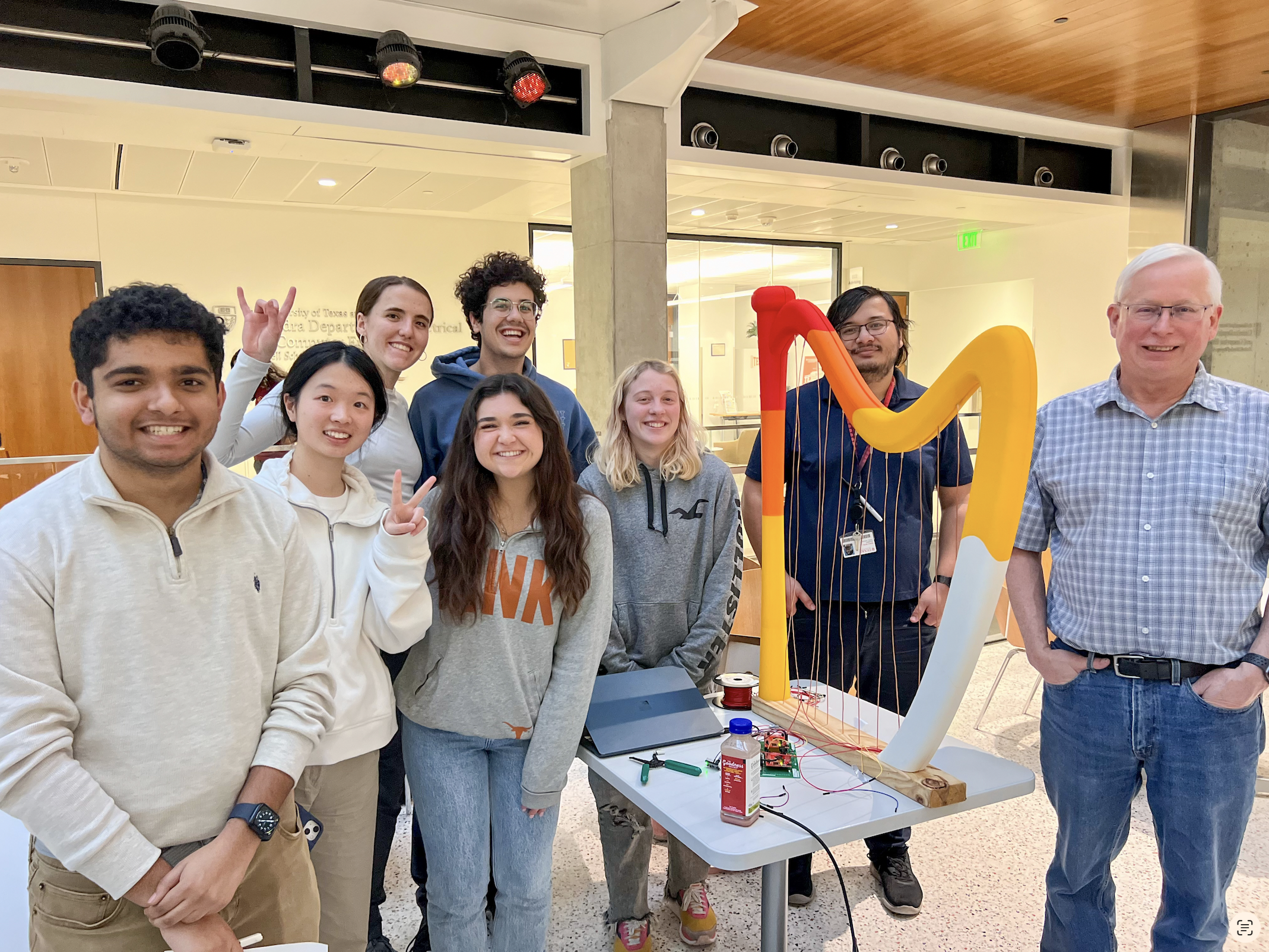
Overview
This project was a full embedded systems capstone-style build completed for ECE 445L Embedded Systems Design Lab at UT Austin in Fall 2023.
The result was a capacitive-touch electric harp with 12 strings, real-time audio synthesis, LED feedback, multiple play modes, and a custom PCB, all housed in a 3D-printed frame over 3 feet tall. The project culminated in a public end-of-semester showcase and competition-style demo.
Unlike a purely software project, this system required integration of firmware, hardware, sensors, and real-time constraints.
My Role & Contributions
While this was a team project, my work focused heavily on the embedded firmware and hardware side, including:
- Writing and integrating core firmware in C
- Implementing capacitive touch sensing using the MPR121
- Writing I²C drivers and sensor interfaces
- Developing audio synthesis and playback logic
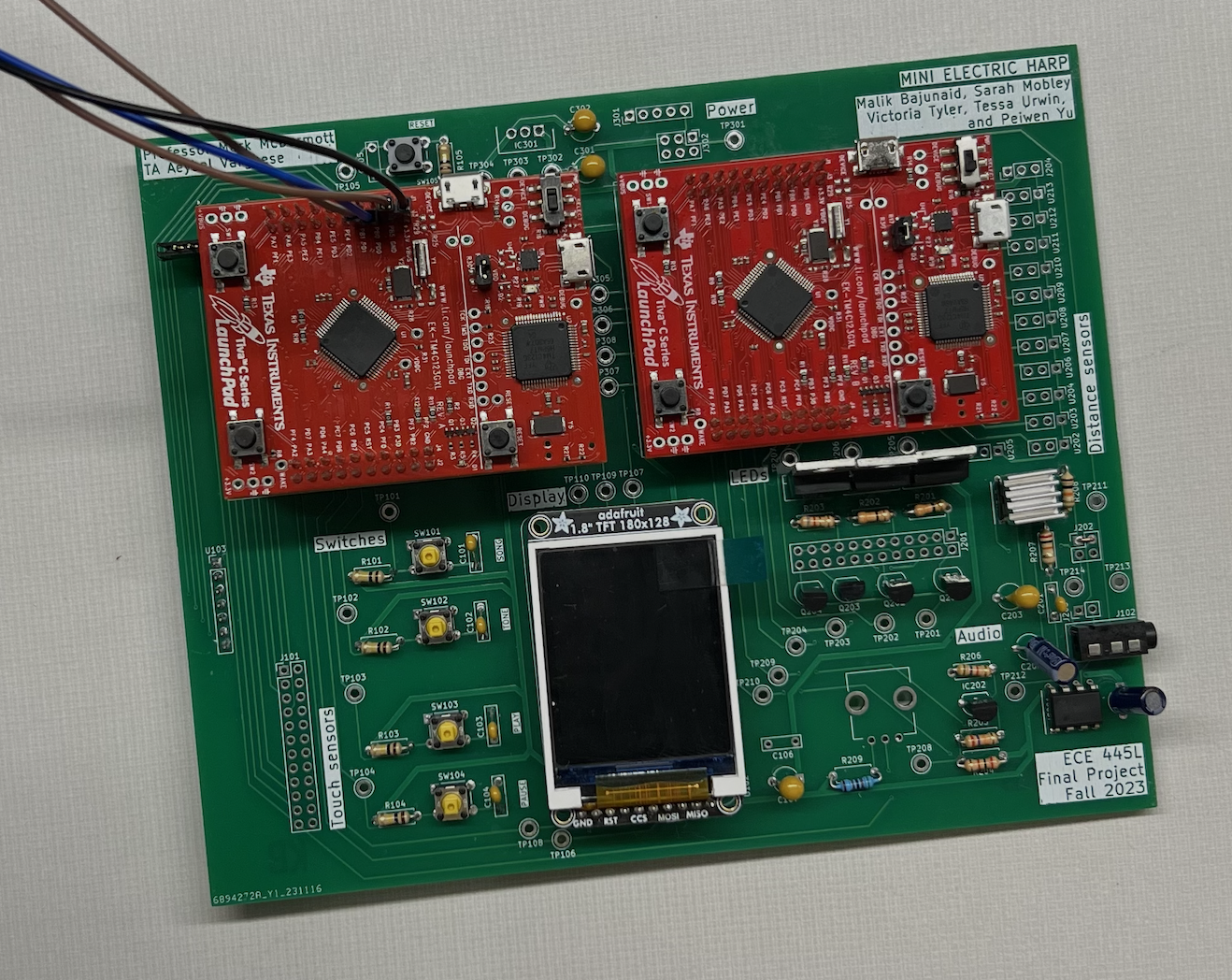
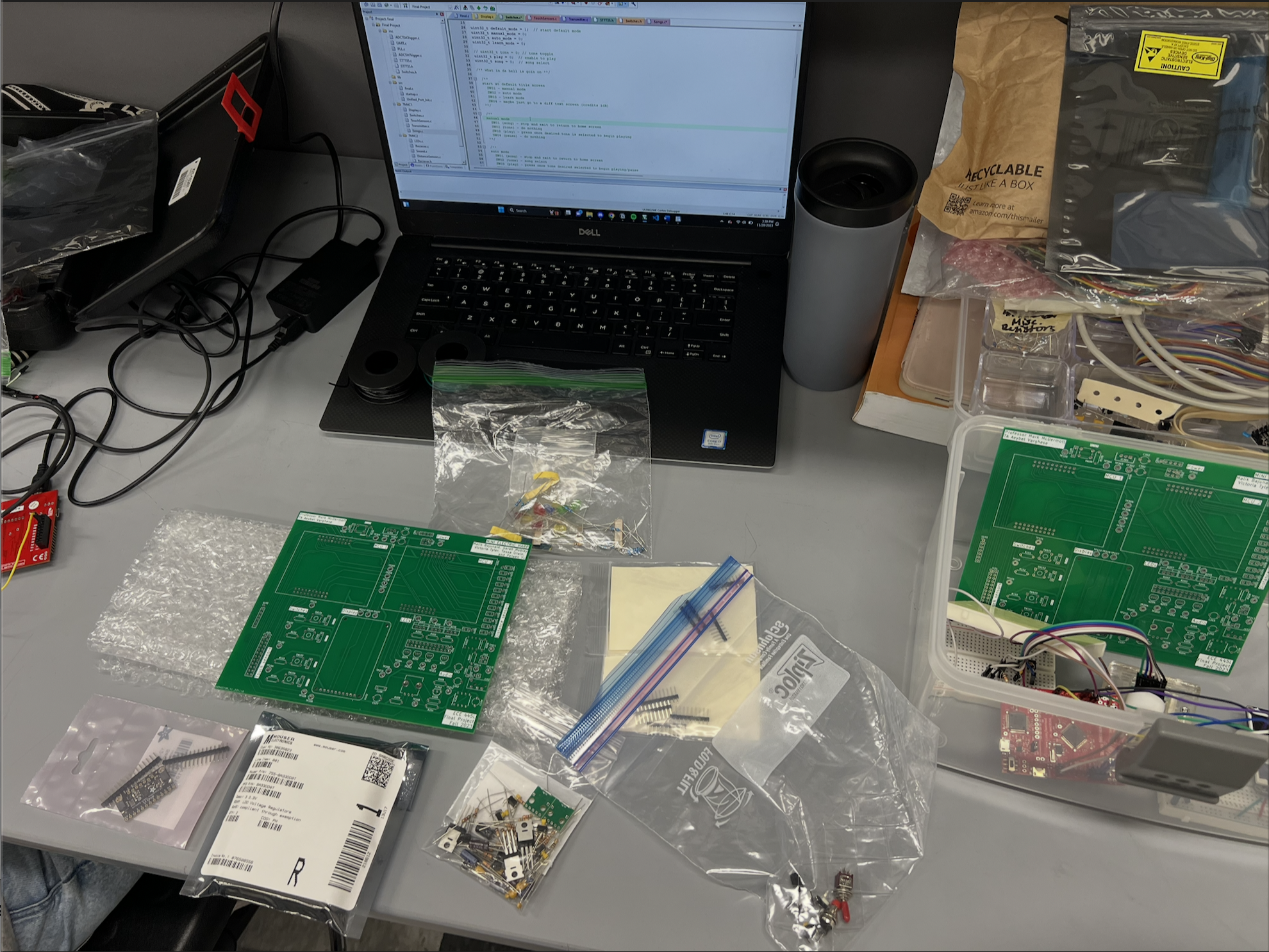
- Designing and debugging the custom PCB
- System integration and real-time debugging
I did not work on the mobile/app interface portion of the project.
System Architecture
The harp system was composed of multiple interacting subsystems:
-
Inputs
- Capacitive touch strings (MPR121)
- Infrared distance sensors (for octave selection)
- Physical switches and controls
-
Outputs
- Real-time audio via DAC + amplifier
- LED string illumination
- LCD display for modes and feedback
-
Controllers
- Dual TM4C microcontrollers communicating via UART
Touch Sensing & Controls
Each string uses capacitive touch sensing to detect when it is played. I implemented the full MPR121 interface over I²C, including:
- Device initialization and configuration
- Per-electrode threshold tuning
- Touch detection and debouncing
- Event-based detection of new touches vs. releases
Touch input is mapped directly to musical notes with minimal latency.
Audio Generation
Audio is generated digitally in real time on the microcontroller:
- Precomputed waveform lookup tables (sine, guitar-like tones)
- DAC output driven via timer interrupts
- Adjustable frequency, octave, and amplitude
- Support for multiple tones and play modes
Care was taken to meet real-time timing constraints so that note playback felt instantaneous and responsive.
Distance Sensing for Octave Selection
Each string is paired with an infrared distance sensor that determines where along the string the user is touching:
- Lower position → lower octave
- Higher position → higher octave
This allows each string to represent multiple octaves, dramatically increasing musical range without adding more strings.
Hardware & PCB Design
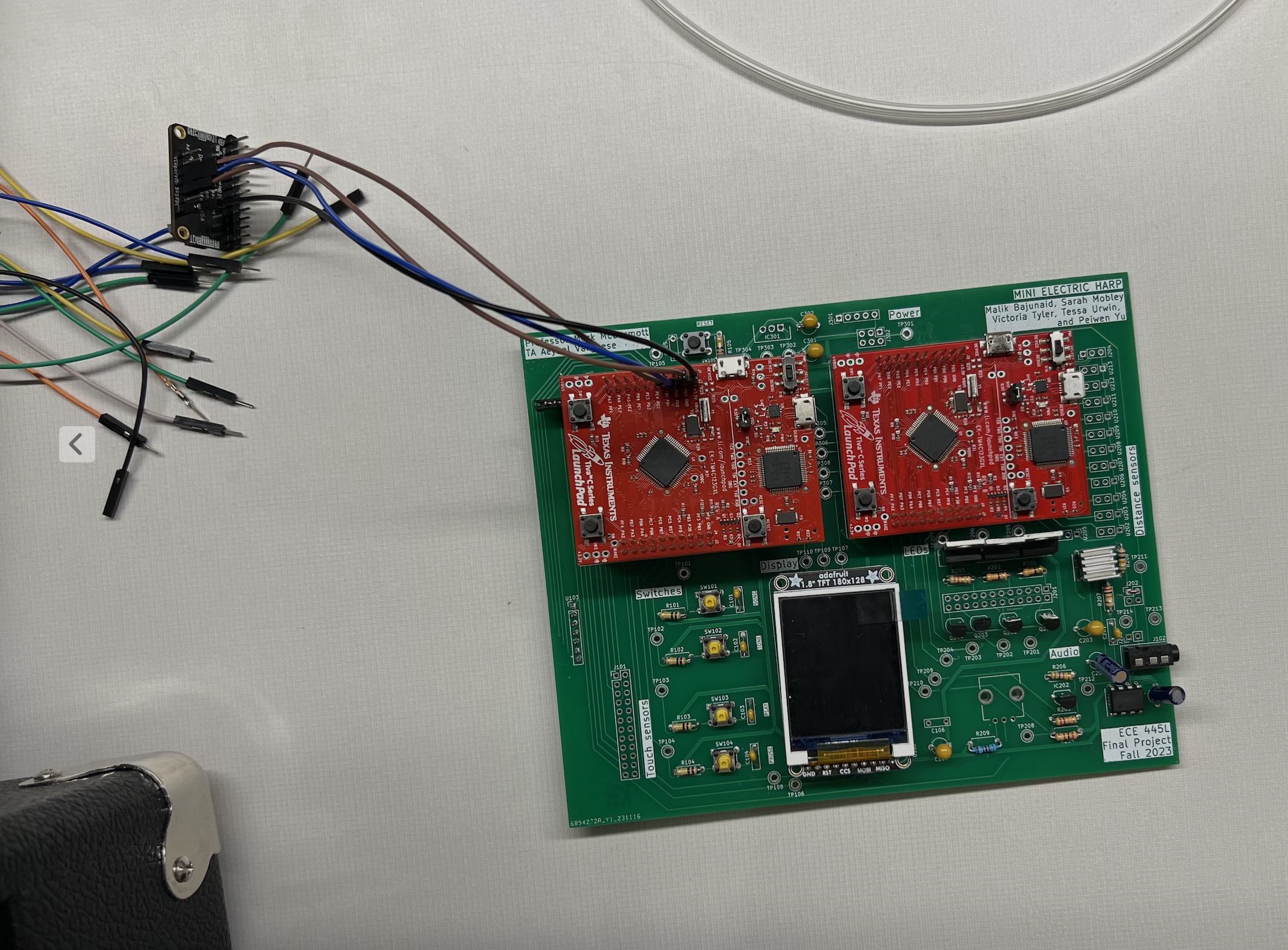
The system was built around a custom two-layer PCB, which I helped design, debug, and bring up. The board integrates:
- TM4C microcontrollers
- DAC and audio amplifier
- Touch and distance sensor interfaces
- Power regulation and signal routing
All electronics were mounted cleanly inside the 3D-printed harp base.
Build & Showcase
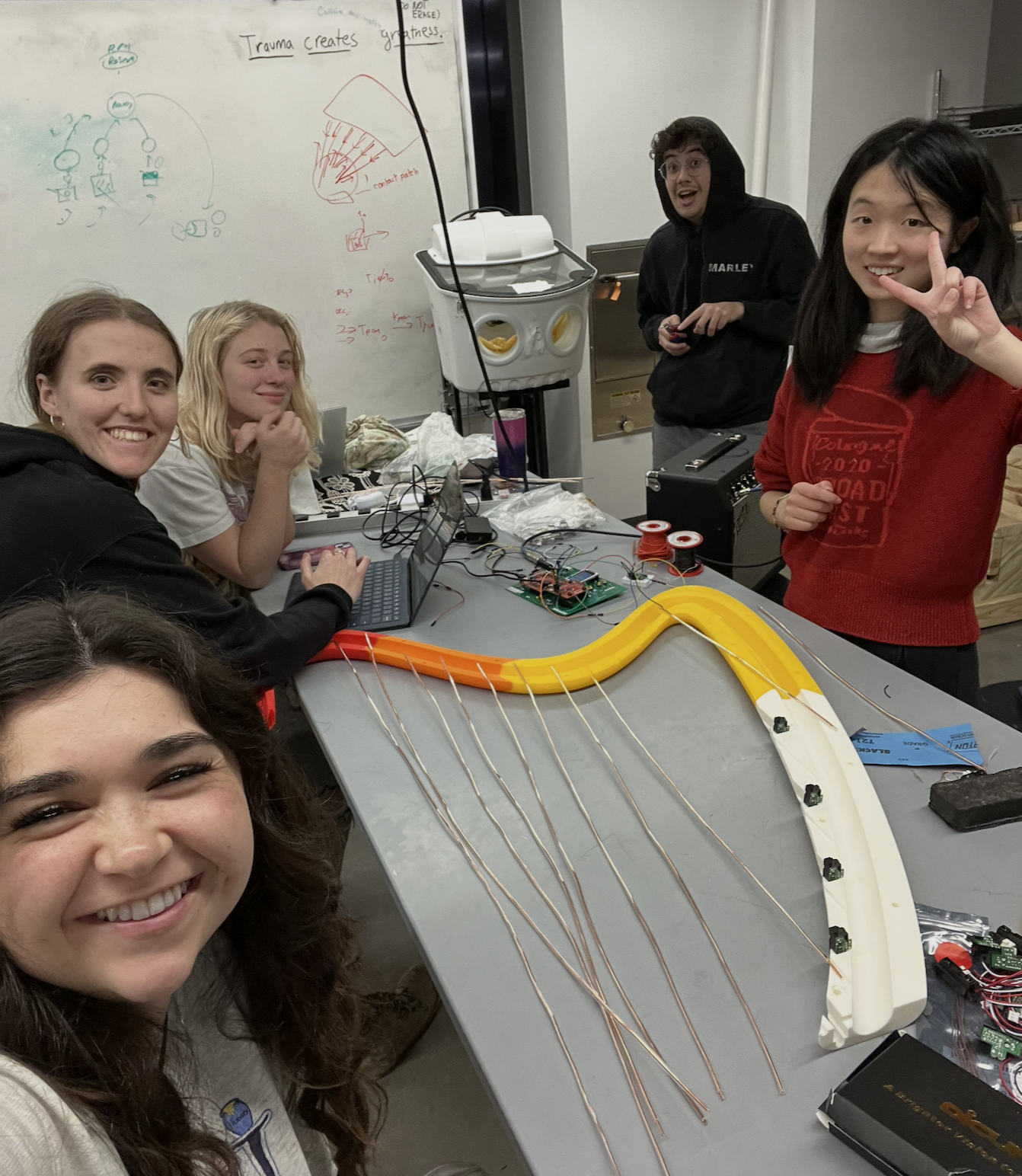
- 3D-printed multi-section harp frame (~3 ft tall)
- Fully self-contained embedded system
- Live demo at final project showcase
- Met all lab constraints for inputs, outputs, ISRs, and system complexity
The project was designed to be both technically rigorous and fun to interact with, and it consistently worked in live demo conditions.
Tools & Technologies
- Languages: C
- MCUs: TM4C (Tiva C Series)
- Interfaces: I²C, UART, ADC, DAC
- Sensors: MPR121 capacitive touch, IR distance sensors
- Hardware: Custom PCB, external DAC, audio amplifier
- Debugging: Oscilloscope, logic analyzer, Keil debugger
Context
Course: ECE 445L – Embedded Systems Design Lab
Institution: The University of Texas at Austin
Term: Fall 2023
Project Type: Team-based final project with live demo
Takeaways
This project strengthened my ability to:
- Write low-level firmware that interacts directly with hardware
- Design and debug real embedded systems, not just simulations
- Manage real-time constraints across multiple subsystems
- Integrate sensors, audio, and control logic into a cohesive system
It was one of my first experiences building something that felt like a real consumer device, end-to-end.
Gallery
Click an image to open full size.